The Story of a Death
_____________________________________________________
This post contains spoilers. It also contains woe-is-me's and profuse sniffles. No wanty, no ready. Kthx
____________________________________________________
Good morning, Vietnam! (or Ferentari. Or somesuch. Yes, I am procrastinating off my subject.) So it's morning, my eyes are puffy, my nose is being obnoxiously sniffly, and I'm feeling rather sleep-deprived. The reason being that I stood up late last night, finishing the last book in the Bartimaeus Trilogy.
So how does one prepare for death? Surely no-one wakes up one day and thinks "Today is the day I die." Yes, this is an old theme for me, and I am aware that I have rarely let my musings reach any further than this. But... I mean... it hits you all the more when you're unprepared for it. Painstakingly, cunningly, willingly unprepared for this.
The Amulet of Samarkand was an unobtrusive read, for all that stands. It seemed like light, pre-teen fantasy. So a little guy summons a demon (in this book - djinni). Because this is how their world is constructed. Ah... let's take a step back and watch.

Stroud's London is pretty well created, and there is just enough background information given to make it palpable and palatable. There is also just enough left out to keep the reader searching for more. An alternate universe 1950something Europe, where Britain is an Empire, where their biggest former enemy is Prague (there's a twist...) and America is still a blooming, though rather disobedient, colony.
Magicians are the ruling caste, with their power deriving from spirits from the Other Place that they summon and bind to their service for a certain period of time.
Cue wannabe- (currently apprentice) magician Nathaniel, who proves his talent and ambition by summoning the most caustic, cynical, infuriatingly hilarious djinni he could possibly find. This is also where things go a bit awry.
For one thing, Nathaniel's reasons aren't quite as innocent as his young age might presuppose: he wants revenge - for a spanking (of sorts)that, in all honesty, he had brought upon himslef. Bartimaeus, the djinni in question, is unwilling to put forth any gratuitous help, makes fun of the whelp, and generally spends amounts of time analyzing everything Nathaniel says or does, looking for ways to break his bonds and have a bit of a magician-snack.
But they do end up being heroes, of course, saving the day, saving the Empire from being devoured by a plot (and a mighty creature). And the action is fast-paced, with all loose ends nicely tied up, with incredibly funny footnotes and snide remarks from Bartimaeus. I tell you, the djinni grows on you.
On the other hand, what I found both fascinating and disconcerting is that, by comparison, Nathaniel does not. It would be rather hard, since he is outlined only by his motives. Practically, that's all that makes his character. We know hardly anything about his physical appearance, he has no mannerisms, no distinctive speech patterns. He's so poorly drawn that he does not strike you as a main character in the least. More like he's built by everything else around him creating his outline in compensation of his lack of substance.
Cue book two. Where Nathaniel gets his right reward for putting his neck on the line and is now, at the tender age of 14, in a rather powerful position and rising fast in the Government. But... um... that is a 14-year-old?! Those are what his thoughts, ambitions and worrie should be?! Damn, three quarters of the Globe's population must have been retarded when they were 14, and none of my friends had to deal with intrigue, politics, reading character and having insightful insights before they even hit puberty properly...

However, the second book was heart-warming. Nathaniel begins to discover a bit of his mistake, of having so complacently settled into his life as a magician when the non-magical populace is treated little better than slaves. Cue also the entrance of a new "main" character. Kitty, Resistance fighter, girl about his age. Are you seeing what I'm seeing happening in the near future?
I found the Golem's Eye gratifying, if only for the fact that I almost guessed at the plot (and by this I mean the "plot plot plot" plot, not the literary one) before it was actually revealed. Though, whether I'm getting smarter or the book was predictable is up to everyone else who read it. TP was impressed by a couple of points I made, as far as I remember, so that's my pat on the head for the year.
Also, towards the very end of the book, several more revelations are hinted at regarding Bartimaeus' past and connections with his most important master, Ptolemy of Alexandria. Aaaah, says I, so the book is finally getting some depth... Well, yes, they were heroes again, they ended up saving the day yet again, albeit a bit unwittingly. But this series of adventures had a certain empty feeling to it.
It was like stick figures were drawn, given names, then put into several disjointed pannels that fed their adventures' climax up to the final two-page spread (manga readers will prolly know what I'm talking about) where they can be glorious heroes. As a reward to them behaving so well, the writer adds a bit more color and shading to their stick-figure silhouettes.
But finally, finally, the book was gaining a third dimension! It has depth, and a certain something. Sure there's a voice at the back of your head singing how you were set up for it, what with all the emphasis of characterisation and the like being placed almost solely on Bartimaeus, but what the hell! A character with a secret, with a past! With a sequel!
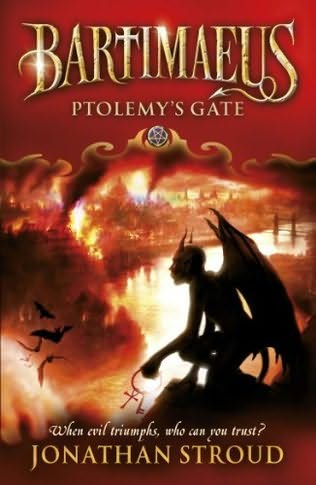
This being the sequel. The last book. The frigging bane of my existence! (or at least, of whatever inspirational energies should have been aimed at perfecting my thesis paper.) Ptolemy's Gate.
Nathaniel dies. The pattern manifests itself not only in the rise and fall of empires, but at an individual level as well. He relives the fate of Ptolemy. He redeemes himself but still dies for it. Kitty makes an incredible sacrifice to form the ultimate bond with Bartimaeus. Nathaniel welcomes the djinni in his own body, and together they lead an almost-epic battle (which, again, rather lacked depth, but was action-fun all the way). And in the end...
In the end, Kitty is left aimless. Nathaniel does not honor his promise (in fact, he had no intention to). He gives Bartimaeus the ultimate gift a human could to a djinni. And he thanks him for being a good servant. After which the bicker a bit, like in the good days.
What do you say to something like that?
And I ended the book crying my eyes out. Telling myself to slow down while reading its final pages. I couldn't bear the thought of the gaping hole in Nathaniel's side. And I also ended the book hating Bartimaeus. He's the king of escaping! He could have come up with a goddamned plan!
And also, and lastly... he had one more charge. He was charged by his master to say hello to Kitty for him. He had to do that one last thing for him. Deducing from a footnote where he was saying "I forgot to ask Kitty how old she was then. Now I'll never know", he never did what he was charged to do.
He got to live for another 5000 years, maybe, carrying with him the memory of two masters who had died and let him live. Somehow, no matter what the romantics will say, that does not strike as punishment quite as it should.
I don't know why I wanted Bartimaeus to do somehting more. The books had not been built like that. It's just that... There was no closure, only the open wound. Nathaniel was dead.
Lemming OST: Angtoria - Six feet under's not deep enough. Somehow unfitting...
Labels: visions with pages
posted by lemming @ Wednesday, June 11, 2008
0 Comments


0 Comments:
Post a Comment
Subscribe to Post Comments [Atom]
<< Home